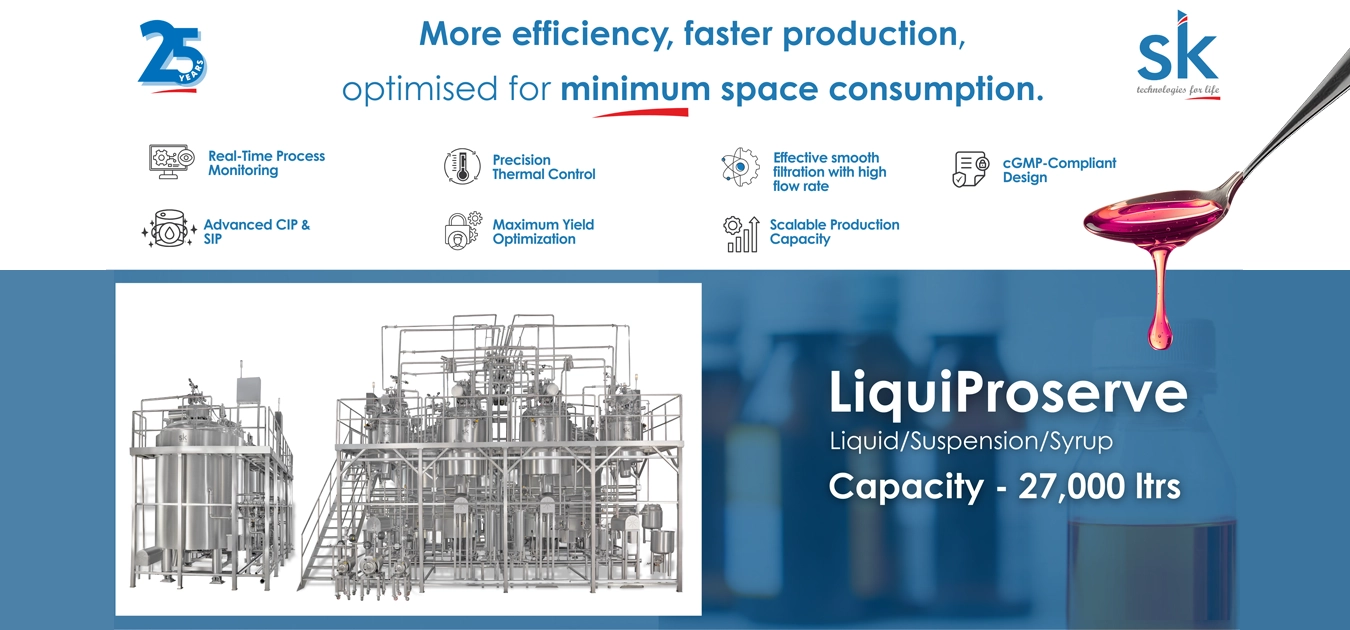
Every product has its own process requirements. Yet process equipment is often selected as if one standard configuration can fit them all.
So, if the product is unique, why should the equipment be standard?
In process manufacturing, equipment selection often starts with a simple question:
“What capacity do we need?”
But capacity is only one part of the equation.
Two products may require the same vessel volume and still require completely different equipment configurations.
Because the process—not just the batch size—determines how the equipment needs to perform.
The Product Defines the Process
Every formulation behaves differently during processing.
Factors such as viscosity, density, shear sensitivity, mixing behaviour, temperature requirements, vacuum requirements and product transfer characteristics can directly influence equipment design.
For pharmaceutical and sterile applications, additional considerations such as hygienic design, cleanability, CIP/SIP and aseptic requirements become equally important.
This is why a vessel designed around capacity alone may not deliver the required process performance.
The product specification becomes the starting point for the equipment specification.
When the Process Changes, the Equipment Changes
A process-driven approach can influence key aspects of equipment design:
- Mixing & Agitation— Impeller type, geometry, speed and power requirements need to suit the product behaviour and desired mixing outcome.
- Heat Transfer — Heating and cooling requirements influence the heat-transfer arrangement and control strategy.
- Homogenisation — Where dispersion, emulsification or particle-size reduction is required, homogenisation needs to be considered as part of the overall process design.
- Vacuum Processing— Processes involving de-aeration or reduced pressure require the vessel and associated systems to be designed accordingly.
- CIP/SIP & Aseptic Processing— Pharmaceutical and sterile applications require appropriate consideration of cleanability, drainability, sterilisation and aseptic requirements.
- Automation & Process Control— Critical process parameters, operating sequences, alarms and interlocks need to be aligned with the process requirements.
- These are not simply features added to a standard machine.
They are engineering decisions driven by the process.
What Does Customised Equipment Really Mean?
Customisation is not simply modifying a standard machine to match a specification.
It starts with understanding:
What is the product?
How does it behave during processing?
What does the process need to achieve?
What equipment configuration can consistently deliver that outcome?
The final design may therefore require changes to the mixing system, vessel configuration, heat-transfer arrangement, vacuum system, instrumentation, automation or cleaning philosophy.
The objective is not to customise equipment for the sake of customisation.
It is to engineer the right equipment configuration for the process.
The SK Approach
At SK, we look at process equipment as part of the manufacturing process not as an isolated machine.
Our engineering approach connects:
Product Characteristics → Process Requirements → Equipment Design → Process Performance
Because the right equipment is not necessarily the one that simply fits the specification sheet.
It is the one that fits the process.
Because the right question isn’t:
“Which machine should we buy?”
It is:
“What does our process need the machine to achieve?” That’s where process engineering makes the difference.
To know more – www.skindus.com
Engineering Better Processes. Enabling Better Manufacturing.
Core Strengths
- Process engineering-driven design
- Custom-built pharmaceutical systems
- Automation and control integration
- CIP/SIP-ready equipment
- Global project experience
Applications
- Syrups and suspensions
- Creams and ointments
- Lotions and gels
- Oral liquids
- Sterile and pilot-scale systems
Engineering Focus
- cGMP-compliant design
- SS 316/316L construction
- PLC, HMI, SCADA systems
- Data integrity and validation support
Final Checklist Before Buying
Ask these key questions:
- Does it match my process and batch size?
- Is it hygienically designed and easy to clean?
- What level of automation is included?
- Does it support validation and documentation?
- Can it scale with future growth?
- What is the total lifecycle cost?
Conclusion
Selecting the right process machinery is critical for pharmaceutical success. The best equipment improves quality, efficiency, and compliance but the real value comes from choosing the right engineering partner.
SK – Technologies for Life focuses on delivering complete, scalable, and compliant process solutions that help pharmaceutical manufacturers build reliable and future-ready plants. Because in pharma manufacturing, the right process solution makes all the difference.
Contact us today to discuss your requirements.
Warm Regards,
Team SK
+91 77380 45459 | www.skindus.com